
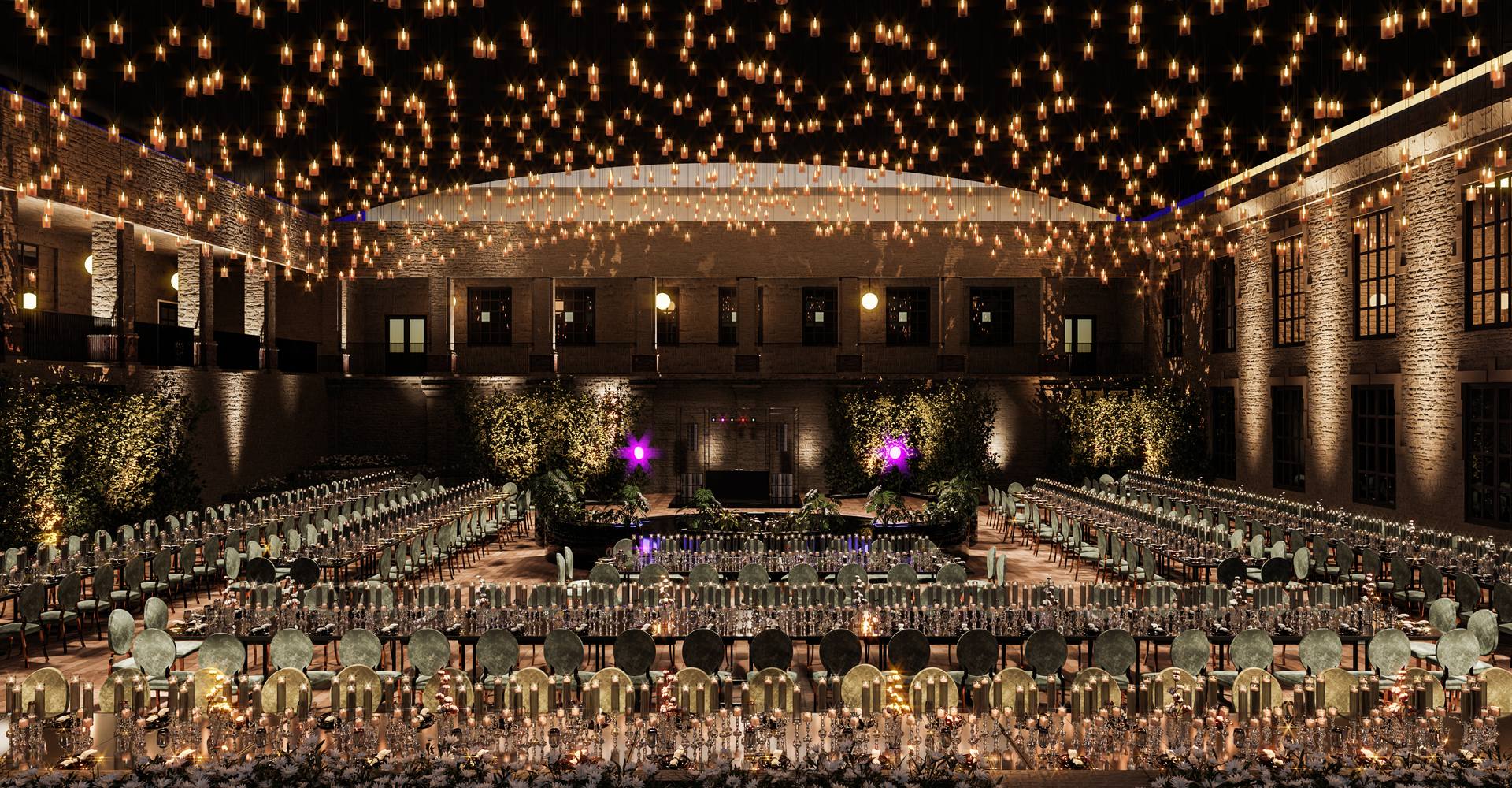
Nobody publishes rendering prices, which is why you are here. So here they are, with the reasoning behind them — what a 3D rendering actually costs in 2026, why the range is so violent, and how to tell whether the number in front of you is fair.
The short answer
For a photoreal image from a professional studio serving the US market:
- Event and wedding visuals: sold by the event. Packages for one event usually land between $1,000 and $3,500 — ours is $1,000 for 5–8 visuals: the ceremony, the reception and the details.
- Architectural and interior renderings: $600 – $2,500 an image from a US studio. Mid-tier studios run $800 to $2,000, premium firms $2,500 and up, and offshore shops $200 to $800. Package pricing changes the math: the model is the expensive part, and every extra angle reuses it.
- 3D animation: from $2,500 a minute. Priced by finished minute, and a good one is shorter than you think.
- 360° virtual tours: quoted per project, and much cheaper when they reuse a model you already paid for.
Those are the numbers. The rest of this explains why they are what they are.
Why the range is so wide
Because "3D rendering" now describes three completely different products that happen to end in a JPEG.
1. The machine floor: about four cents
An AI image generator will make you a beautiful room for roughly the cost of nothing. It is genuinely useful — for exploring a mood, for a pitch deck that promises nothing, for getting unstuck.
What it cannot do is be accurate. An AI image is generated from a description, so it does not know your ceiling is nine feet, that the window is on the north wall, or that the chair you specified is the one your rental company actually stocks. It produces something that resembles your project. Your client, who is about to spend money, will eventually notice the difference — and the moment they catch one thing that is wrong, they stop trusting all of it.
The cheap image is not expensive because of what it costs. It is expensive because of what it costs you when the client stops believing the picture.
2. The labor floor: $25 an hour
Freelance marketplaces will connect you with someone who will model your project for around $25 an hour. Some of them are excellent. What you are not buying, at that price, is judgment: nobody is deciding where the sun should be, what the camera should do, or which of the four angles you asked for is the one that will actually sell the room. You are buying hands, and you are supplying the head.
That is a real option if you have the head. Most planners, architects and builders do not have the time to art-direct a render, which is the whole reason they hired someone.
3. The studio: $250 – $2,500 an image
Here your project gets modeled from your real drawings, lit by someone who has lit two hundred rooms before yours, framed by someone who knows which angle closes a sale, and checked by someone whose name is on it. The image survives a client zooming in, because everything in it is actually there.
The spread inside this tier is mostly geography, not quality: a US studio carries US payroll and starts around $600; a nearshore studio — same craft, same software, lower cost base — can start around $250. The test is not the flag on the invoice. It is whether the studio models your real drawings and shows you the angle before rendering.
Above about $2,500 an image you are usually paying for a brand, a marquee client list, or a very long queue. Sometimes that is worth it. Often it is not.
The five things that actually move your price
- How much has to be modeled from scratch. This is the big one. Building the 3D model is most of the work; making pictures of a model that already exists is comparatively cheap. It is why the second image of a project costs a fraction of the first.
- How many final images you need. Order five at once and the per-image price drops, because they all reuse the same model. Order them one at a time over three months and you pay setup five times.
- How much context. A building floating on white is one price. The same building in its real street, with its real neighbors, at dusk, with traffic, is another.
- Revisions. One or two rounds are standard and should be included. Unlimited revisions are not free; they are priced in somewhere, and if a studio offers them without a limit, look for where.
- Speed. Rush work costs more everywhere, and it is the most avoidable charge on any invoice. It exists because someone did not ask early.
How to pay less without getting a worse image
None of these are tricks. They just remove the waste that you would otherwise be billed for.
- Send complete drawings. Every missing dimension turns into an email, and enough emails turn into an extra day.
- Decide the finishes before rendering starts. Changing the tile after the image is lit is a revision. Choosing the tile before it is lit is free.
- Buy the set, not the image. The model is the cost. Amortize it.
- Ask for a fixed price up front. A studio that will not quote a fixed price is telling you it does not know how long your job takes.
- Be honest about the deadline. Real deadlines get planned around. Fake ones get charged for.
What we charge, and why we publish it
Architecture and development is sold as a package, not as a shopping list: $2,000 for eight final views, $3,500 with a navigable 360° tour, $9,000 for a full launch with fifteen to twenty views, the tour, a 60-second animation, a vertical cut for social and a digital sales room. Interiors and remodels, where three to five images is the whole job, stay priced per image from $250. Events are sold by the event: $1,000 for a full package of 5–8 visuals. Animation on its own from $2,500 a minute. Reference prices for typical projects; every project is quoted on its own scope and complexity, at a fixed price, before it starts.
For context: mid-tier US studios run $800 to $2,000 an image, premium firms $2,500 and up, and offshore shops $200 to $800. We are a Mexican studio working US Central Time, staffed by artists, not a render farm and not a prompt.
We publish the numbers because the alternative wastes your time and ours. If we are out of your range, you should find that out here, in ten seconds, rather than in a twenty-minute discovery call designed to soften you up before a reveal.
What you get for it: your actual project, modeled by hand from your actual drawings. An artist who decides where the light goes. Revisions that come back the same day, because we work US Central Time. And an image that holds up when your client leans in — which is the only test that has ever mattered.